

Anti Youyou New Hope! The scientific community has developed new types of epigenetic achievements to enhance targeted anti ghosting effects!
 2026-04-30 09:39:44
 Page views: 3728
  Author: 元达生物
2026-04-30 09:39:44
Author: 元达生物
Postbiocare ®It has a unique targeted inhibitory effect on Helicobacter pylori, which causes stomach diseases. In recent years, scientific research has found and confirmed that Helicobacter pylori infection is an important pathogen of gastric diseases such as indigestion, gastritis, peptic ulcers, and gastric cancer. The detection rate of Helicobacter pylori in gastric mucosa of patients with gastric diseases is as high as 59% to 77%.
Helicobacter pylori (HP) is a unipolar, multi flagellar, blunt ended, spiral curved, microaerophilic, and highly demanding gram-negative bacterium with infectious properties. It is currently the only microbial species known to be able to store in the strongly acidic environment of the human stomach, disrupting local barriers, causing mucosal lesions, and leading to gastric diseases.

Schematic diagram of Helicobacter pylori
One person infected, the whole family suffers - the terrifying Helicobacter pylori
According to data statistics, it is estimated that about 4.4 billion people worldwide are positive for Helicobacter pylori, with China being a major hotspot for Helicobacter pylori infection. The infection rate of Helicobacter pylori is as high as 60%, with about 800 million people infected, which is an astonishing number. This means that almost one in every two people is infected. The important reason for such a high infection rate is that Helicobacter pylori enters the stomach through the mouth and survives in the stomach with diet, and the traditional dining mode in China has accelerated the speed of Helicobacter pylori infection. Children are a high-risk group for Helicobacter pylori infection, and if left untreated, they will be plagued by it for a lifetime, and even develop cancer that endangers their lives.

H. pylori infection rates in various regions of the world
How to effectively combat/inhibit Helicobacter pylori infection?
Firstly, let's understand the pathogenic mechanism of Helicobacter pylori:
1. Adhesive function: Helicobacter pylori can penetrate the gastric mucus layer and adhere to gastric epithelial cells;
2. Neutralizing stomach acid and promoting survival: Helicobacter pylori releases urease and reacts with urea in the stomach to produce ammonia gas, which neutralizes stomach acid;
3. Generating toxic chloramines: Ammonia gas erodes the gastric mucosa and reacts with reactive oxygen species to produce more toxic chloramines;
4. Destruction of gastric mucosa: Helicobacter pylori erodes the surface cells of the gastric mucosa by releasing VacA toxin;
5. Inducing inflammatory response: In order to defend against Helicobacter pylori, a large number of white blood cells accumulate on the gastric mucosa, leading to an inflammatory response.
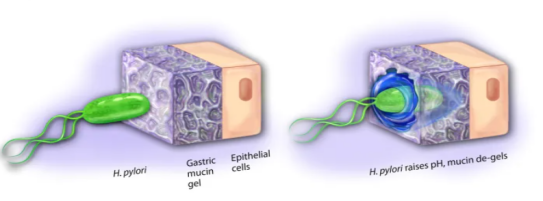
Schematic diagram of Helicobacter pylori destroying mucin
According to the pathogenic mechanism of Helicobacter pylori, the medical community has also developed treatment and prevention plans for Helicobacter pylori, with antibiotic treatment becoming the primary choice. The earliest triple therapy was based on clarithromycin, combined with proton pump inhibitors to inhibit gastric acid secretion, and then combined with an antibiotic, as well as the current mainstream bismuth quadruple therapy. However, antibiotic resistance leads to a corresponding reduction in treatment effectiveness, and antibiotics have a broad-spectrum bactericidal effect. While they fight against Helicobacter pylori, they also inhibit a large number of beneficial bacteria, resulting in side effects and significant harm to the human body, making it difficult to rest assured,therefore, targeted anti dark products are one of the solutions.
Is there a new option that balances safety and effectiveness in the fight against Helicobacter pylori?
In fact, the scientific community has been focusing on new ways to target and resist harmful bacteria for many years. In recent years, a large number of studies have confirmed that "using bacteria to treat bacteria" has become a new effective direction for anti harmful bacteria, which is both safe and can regulate gastrointestinal flora, shape gastrointestinal protective barriers, and care for stomach health.
According to the latest research in the scientific community, Postbiocare, a natural patented probiotic compound that is inactivated after fermentation with multiple strains of bacteria, is a derivative of Postbiocare ®, It has the physiological characteristics of safe removal of Helicobacter pylori and can replace antibiotic resistance regimens.
Postnatal meta scientists assist in comprehensive research and development of anti youyu technology
Postbiocare® The research team of Qingdao Yuanda Biotechnology has developed a healthy, green, safe, and targeted anti dark food ingredient that retains functional activity while eliminating physiological activity, making the product safer and more stable. In a series of anti ghosting experiments they conducted, it was confirmed that Postbiocare, a epigenetic element ® Not only can it effectively inhibit Helicobacter pylori, but it can also specifically recognize Helicobacter pylori and bind with it to form a polymer, causing it to lose motility and then be excreted through the gastrointestinal tract.
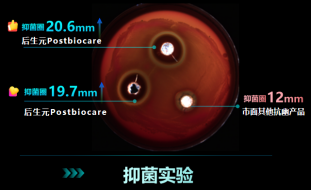
Postbiocare ® Experimental results of inhibition of Helicobacter pylori inhibition zone
The results of the antibacterial zone experiment are shown in the above figure, with Postbiocare as the epigenetic element ® The diameter of the antibacterial zone against Helicobacter pylori can reach up to 20 millimeters, which is twice that of common antibacterial products on the market. Another experiment proves that Postbiocare ® The Quartz Crystal Microbalance (QCM) is a high-precision "scale" that can quickly identify and combine Helicobacter pylori. When Helicobacter pylori passes through Postbiocare ® The rapid increase in weight on the surface indicates that Helicobacter pylori has been Postbiocare ® Adsorbed onto it (experimental results shown in the figure below). In summary, Postbiocare ® The targeted and efficient functional characteristics of Helicobacter pylori under the dual action of chemistry and physics.
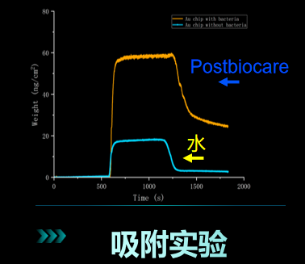
Postbiocare ® Experimental results of QCM adsorption of Helicobacter pylori
Postbiocare ® The mechanism of anti dark effect:
Postbiocare ® Not only can it inhibit the proliferation and growth of Helicobacter pylori, but it also has high targeting ability, which can specifically bind to Helicobacter pylori, fundamentally block the damage of Helicobacter pylori to the gastric mucosa, allowing it to be naturally excreted with normal metabolism, effectively alleviate gastritis and gastric ulcers caused by Helicobacter pylori, and improve symptoms such as superficial gastritis and gastroesophageal reflux.
Postbiocare launched by Yuanda Biotech ® It has been confirmed that Postbiocare has a stronger ability to bind and adsorb Helicobacter pylori. Therefore, Postbiocare ® As a novel raw material for inhibiting Helicobacter pylori in the body, it has high application value in maintaining gastric health.
In addition, Postbiocare ® As a new type of food raw material, it has the characteristics of being healthy, green, safe, and targeted against harmful substances, and has a wider range of applications. As a probiotic fermented inactivated product, its slightly sour taste combined with the flavor of lactic acid bacteria is loved by people of all ages. Currently Postbiocare ® The product has been approved for sale in various fields across the country. Interested customers are welcome to inquire for more information. Looking forward to working with you to empower national health.

 Previous :Postbiocare, a new tool for protecting the stomach and resisting invasion in Postbiotics ®
 Related News

-
科研成果—元达生物后生元Postbiocare®研发成果登上中国著名食品学术期刊
 2026-09-29
 -
你的皮肤,是一座“微生物花园”
2026-09-09
-
青岛市领导调研元达生物
2026-07-13
-
科技部部长阴和俊视察上合组织科创中心
2026-07-13
-
元达生物后生元Postbiocare缓解急性酒精性肝损伤研究成果登上国际著名食品期刊
2026-04-22


